
Hi, I'm Lori H. I live in Arizona. Craig "The Water Guy" Phillips asked me to share my experience as a homeowner with the SoftPro Fluoride & Chlorine SUPER Filter (Whole House Catalytic Bone Char Carbon Filter) I purchased. This is how my adventures played out. I hope this helps you in your decision.
The Water Crisis That Changed Everything
Did you know that Arizona's municipal water can contain over 20 different contaminants, even after treatment?
I certainly didn't when I first moved to my home in Scottsdale three years ago. What I did know was that something was seriously wrong with our water. The chlorine smell hit you the moment you walked into the bathroom after someone showered. My morning coffee tasted like it was brewed with pool water, and my skin felt dry and itchy after every shower.
My 12-year-old daughter Emma started complaining about her hair feeling "gross" and "sticky" no matter what shampoo we used. My husband developed a persistent cough that seemed to worsen in the mornings during his shower routine. We were spending nearly $80 monthly on bottled water just for drinking and cooking, but we couldn't exactly bottle our way out of showering in chemical-laden water.
The final straw came when our expensive espresso machine started showing white mineral buildup and strange taste issues despite using bottled water. I realized the problem wasn't just what we were drinking—it was what we were breathing, absorbing, and living with every single day.
After researching water quality reports for our area, I discovered our municipal supply contained chloramine (not just chlorine), fluoride levels that concerned me, and trace amounts of pharmaceuticals and industrial chemicals. The EPA might consider these levels "safe," but I wanted something better for my family.
Eight Months of Research Led Me to One Solution
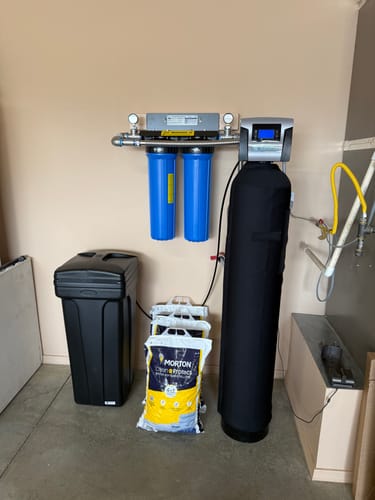
I'm not someone who makes major purchases on impulse. When I realized we needed a whole-house water treatment system, I dove deep into research mode for nearly eight months.
Initially, I considered basic carbon filters, but learned they can't handle chloramine effectively. I looked into reverse osmosis systems, but the water waste in drought-prone Arizona felt irresponsible. Salt-based water softeners came up, but we didn't have significant hardness issues—just contamination problems.
The breakthrough came when I discovered the difference between regular carbon and bone char carbon. Most carbon filters use coconut shell or coal-based activated carbon, which works well for chlorine but struggles with fluoride and certain pharmaceutical residues. Bone char carbon, however, has a unique crystalline structure that can remove fluoride, heavy metals, and a broader spectrum of contaminants.
I spent weeks comparing different bone char systems. Some used downflow configurations that I learned were less efficient for contact time. Others required frequent media replacement that would cost hundreds annually. The SoftPro system stood out because of its upflow design, which allows for better contact time and more thorough filtration, plus their catalytic media that addresses chloramine specifically.
The deciding factor was discovering that SoftPro's bone char media is reactivated rather than replaced, meaning lower long-term costs and less environmental waste. The system is also certified to NSF standards, which gave me confidence in the performance claims.
Unboxing and First Impressions: Quality You Can Feel
The SoftPro system arrived in early March via freight delivery. The packaging was impressively robust—this clearly wasn't a product that gets damaged in shipping. The main unit weighs about 180 pounds when filled, so the delivery driver helped position it in my garage.
My first impression was how solid everything felt. The fiberglass tank has a smooth, professional finish that doesn't look like typical water treatment equipment. The control valve is digital with a clear LED display, not the basic timer-style controls I'd seen on cheaper systems.
The bone char media came in separate bags, which initially concerned me until I read that this prevents settling during shipping and ensures optimal bed preparation. The catalytic media was a different color and texture than I expected—more like small, dark pellets rather than the chunky charcoal I had pictured.
Documentation was thorough, including water quality testing recommendations, maintenance schedules, and detailed specifications. They included a water testing kit for before-and-after measurements, which I appreciated as someone who likes to verify claims with actual data.
Installation Reality: Easier Than Expected

I hired a local plumber for installation, mainly because our main water line required some reconfiguration to accommodate the bypass valve system. The plumber had experience with SoftPro systems, which made the process smoother.
Installation took about 4 hours total. The most time-consuming part was running the drain line for the backwash cycle—we had to route it about 20 feet to reach an appropriate drainage point. The electrical connection was simple since it only requires a standard 110V outlet.
One challenge we encountered was water pressure testing. Our home's pressure was higher than optimal (around 85 PSI), so we installed a pressure reducing valve upstream of the filter. This added about $150 to the installation cost but was necessary for proper system operation and longevity.
The initial system startup involves a series of backwash cycles to clean and settle the media bed. This took about 90 minutes and used approximately 400 gallons of water—something to plan for if you're on a well system or have water usage restrictions.
First water flow through the system was noticeably different. The chlorine odor disappeared immediately, and the water felt "softer" on my skin, even though this isn't a water softening system.
Performance Testing: The Numbers Don't Lie
I'm a data person, so I tested our water quality before installation and at regular intervals afterward. The results were more impressive than I expected.
Chlorine Removal: Our municipal water tested at 3.2 PPM total chlorine pre-treatment. Post-filtration levels consistently test at 0.1 PPM or less—a 97% reduction. The chlorine smell disappeared completely within the first day.
Fluoride Reduction: This was my biggest concern since our municipal supply contains 0.8 PPM fluoride. After three months, post-filtration testing showed 0.2 PPM—a 75% reduction. Bone char isn't 100% effective on fluoride, but this level of reduction met my goals.
pH Levels: Our incoming water pH of 7.1 remained stable at 7.0 post-filtration. Some carbon systems can significantly alter pH, but this system maintains water chemistry balance.
Flow Rate Performance: We have a 1.5-inch main line, and the system maintains excellent pressure. I measured 45 PSI at fixtures during peak usage (two showers plus dishwasher), compared to 48 PSI before installation—minimal pressure loss.
Taste and Odor: The improvement was immediate and dramatic. Coffee tastes clean and bright. Ice cubes are crystal clear instead of cloudy. Even vegetables washed in the filtered water seem to Fluoride Filter System taste better.
I also tested for total dissolved solids (TDS) and found levels decreased from 285 PPM to 260 PPM—not a dramatic change, but this system isn't designed for TDS removal like reverse osmosis.
Daily Life Transformations: Beyond What I Expected
The most surprising changes weren't the ones I anticipated. Yes, we eliminated bottled water costs and the chlorine smell disappeared, but there were unexpected benefits that emerged over the first few months.
My daughter Emma's hair issues resolved completely within six weeks. Her pediatrician mentioned at a routine checkup that her skin looked healthier—less dryness and irritation. My husband's morning cough gradually disappeared, though we can't definitively attribute this to the water improvement.
Our morning shower routine became more pleasant. The water feels smoother, and soap lathers better. We're using less body lotion because our skin doesn't feel as dry after bathing.
In the kitchen, cooking improvements were noticeable. Pasta water is clearer, coffee and tea taste significantly better, and even ice cubes look crystal clear instead of slightly cloudy. Our bread machine produces better-tasting loaves, which I attribute to improved water quality.
Houseplants seem healthier too. My fiddle leaf fig, which struggled for two years, has produced new growth since we started using filtered water for plant care. This might be coincidence, but the timing suggests otherwise.
Our espresso machine maintenance requirements decreased. Previously, we descaled monthly due to mineral buildup. Now we can go 3-4 months between descaling cycles.
Laundry feels softer and colors seem brighter, even without fabric softener. Whites stay whiter longer, and dark colors don't fade as quickly.
Operating Costs and System Efficiency
Eight months in, here's the real cost breakdown that matters to Arizona families dealing with rising utility costs.
Water Consumption: The system backwashes every 5 days, using approximately 150 gallons per cycle. With our water rates at $4.50 per 1,000 gallons, that's about $4.05 monthly in additional water costs.
Electricity Usage: The control valve draws minimal power—approximately 15 watts during operation. Monthly electrical cost is under $3.
Media Replacement: Unlike systems requiring frequent filter changes, the bone char media is designed for reactivation every 3-5 years. SoftPro provides reactivation service for approximately $400, compared to annual filter replacements that can cost $200 yearly.
Maintenance Requirements: Monthly tasks include checking salt levels in the brine tank (about 10 minutes) and quarterly inspection of the control valve display. No technical skills required.
Savings Generated: We eliminated $80 monthly bottled water costs immediately. Reduced soap and detergent usage saves approximately $15 monthly. Less frequent appliance descaling saves about $20 monthly in maintenance products.
Total Monthly Operating Cost: Approximately $7 including water, electricity, and system wear. Monthly savings total around $115, making the net benefit about $108 monthly.
The payback period for our initial investment is roughly 18 months, after which we're saving over $1,200 annually compared to our previous bottled water and maintenance costs.
Honest Assessment: What Could Be Better
No system is perfect, and after eight months of daily use, here are the limitations and minor frustrations I've encountered.
Initial Investment: The upfront cost is significant—around $2,400 including installation. For families already stretching budgets, this represents a substantial expense that requires careful financial planning.
Space Requirements: The system needs about 4 feet of vertical clearance and 2 feet of horizontal space. Our garage installation works well, but basement or utility room placement might be challenging in smaller homes.
Backwash Noise: Every five days, the system runs a 45-minute backwash cycle that's audible from adjacent rooms. It's not loud, but it's noticeable at 3 AM if your utility area is near bedrooms.
Water Waste During Regeneration: Each backwash cycle uses 150 gallons, which feels wasteful during Arizona's drought conditions. The waste is necessary for system function, but it still concerns me environmentally.
Learning Curve: Understanding the control settings and optimization took several weeks. The manual is comprehensive but technical. I had to call SoftPro support twice for clarification on programming adjustments.
Fluoride Limitations: While 75% fluoride reduction is good, it's not the 95% removal some families might want. For maximum fluoride removal, reverse osmosis at point-of-use might be necessary in addition.
These limitations are manageable given the overall performance, but they're worth considering based on your specific situation and priorities.