
Hi, I'm Ken J.. I live in California. Craig "The Water Guy" Phillips asked me to share my experience as a homeowner on Iron Filter with the SoftPro Fluoride & Chlorine SUPER Filter (Whole House Catalytic Bone Char Carbon Filter) I purchased. This is how my adventures played out. I hope this helps you in your decision.
Did you know that the average household consumes over 300 gallons of water daily, yet most homeowners have no idea what contaminants are flowing through their taps?
That was me eighteen months ago—blissfully unaware that our municipal water, while meeting basic safety standards, was loaded with chlorine, fluoride, and trace pharmaceuticals that were affecting everything from our morning coffee taste to my family's skin health. The breaking point came when my teenage daughter started complaining about dry, itchy skin after every shower, and honestly, our tap water had developed this persistent chemical taste that made even cooking unpleasant.The Water Quality Wake-Up Call That Changed Everything
Living in California, I'd always assumed our water treatment facilities handled everything. Boy, was I wrong.
The reality hit me during a routine plumbing inspection when our technician mentioned the heavy chlorine smell coming from our faucets. Curious, I purchased a basic water testing kit from the hardware store, and the results were eye-opening. Our municipal water contained 3.2 parts per million of chlorine—well within legal limits, but way higher than what I wanted my family drinking and bathing in daily. But chlorine was just the beginning. After researching our local water treatment reports online, I discovered our supply also contained fluoride levels around 0.8 ppm, plus trace amounts of pharmaceutical residues that standard municipal treatment doesn't remove. The more I learned about disinfection byproducts like trihalomethanes and haloacetic acids, the more concerned I became about long-term exposure effects.The health implications were stacking up:
- Chlorine was drying out our skin and hair The chemical taste was affecting our drinking water and cooking Fluoride concerns for our young children Unknown pharmaceutical residues in our daily consumption Potential formation of harmful disinfection byproducts
Research Journey: Finding the Right Whole House Solution
Diving into water treatment research felt overwhelming initially. How do you choose between dozens of technologies and hundreds of products?
I started by understanding the different filtration technologies available. Standard activated carbon filters handle chlorine and taste issues well, but they're limited against fluoride and certain pharmaceutical compounds. Reverse osmosis systems are thorough but waste significant water and require extensive maintenance. UV sterilization targets bacteria but doesn't touch chemical contaminants. Then I discovered catalytic carbon combined with bone char—a combination I'd never heard of before. Catalytic carbon, I learned, is a specially processed activated carbon that's more effective at removing chloramines and hydrogen sulfide than regular carbon. Bone char, meanwhile, has a unique ability to remove fluoride through a combination of adsorption and ion exchange mechanisms. The SoftPro Fluoride & Chlorine SUPER Filter caught my attention because it combines both technologies in a single upflow system. The specifications were impressive:- Catalytic coconut shell carbon for chlorine and chloramine removal Bone char media for fluoride reduction 10 GPM flow rate suitable for our household Upflow design for better media utilization NSF-certified components 5-year manufacturer warranty
Unboxing and First Impressions: Quality You Can See
The system arrived in a substantial wooden crate—definitely not your typical cardboard box delivery. This thing was built like a tank.
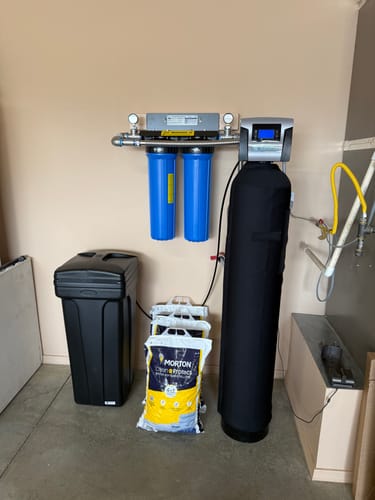
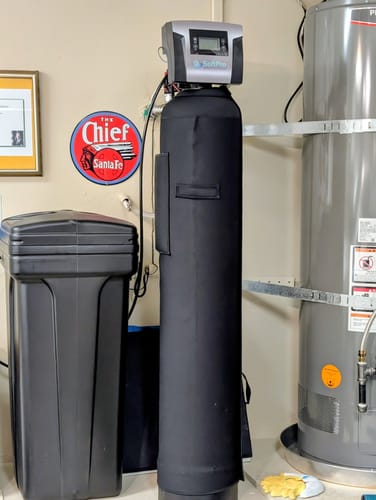
Unpacking revealed a 10" x 54" fiberglass tank with a striking blue color and professional-grade fittings. The control valve was a Fleck 5600SXT, which I'd read was considered the gold standard in residential water treatment. The build quality was immediately apparent—heavy-duty construction with brass fittings and a robust control head. Included components were comprehensive:- Pre-loaded media tank with catalytic carbon and bone char Fleck 5600SXT control valve Installation kit with bypass valve and fittings Detailed installation manual Programming instructions for the control valve Water testing guidelines
One detail that impressed me was the media loading. Unlike some systems that arrive with loose media bags, this came pre-loaded and ready for installation. The layering of different media types was clearly engineered for optimal performance, with the bone char and catalytic carbon strategically positioned for maximum contact time.
Installation Experience: Easier Than Expected

I'll be honest—installing a whole house water filter intimidated me initially. Would this require major plumbing modifications?
The answer was surprisingly no, though having basic plumbing skills definitely helped. The installation took about four hours, including time to study the manual and make careful measurements. Here's how it went: Pre-Installation Setup:I chose a spot in our basement about 6 feet from where the main water line enters the house. The location needed to accommodate the tank height (about 5 feet total), provide access for maintenance, and include a drain for the automatic backwash function. I also installed a dedicated 110V outlet for the control valve. Plumbing Integration:
The main water line required cutting and installing the bypass valve assembly. I shut off water at the meter, drained the line, and made the cuts with a pipe cutter. The Fluoride Filtration bypass valve kit included all necessary fittings for 1" copper pipe, though adapters are available for other pipe types. System Connection:
Connecting the tank to the bypass valve was straightforward—the inlet and outlet ports are clearly marked, and the included flexible connectors made alignment easy. The control valve mounts directly on top of the tank with a simple bayonet connection. Programming the Control Head:
The Fleck 5600SXT required programming for our specific water conditions and household size. The manual provided step-by-step instructions for setting backwash frequency, flow rates, and regeneration timing. I set it for a 7-day backwash cycle based on our family size and usage patterns.
First Startup:
After installation, the system required about 30 minutes of flushing to remove any loose media particles and activate the carbon. The initial water had a slight cloudy appearance, which cleared completely after the recommended flush period.
Performance Testing: Measuring Real Results
Here's where the rubber meets the road—does this system actually work as advertised?
I tested water quality before installation and at regular intervals afterward using both home test kits and professional lab analysis. The results were honestly better than I expected: Chlorine Removal:Pre-filter: 3.2 ppm chlorine
Post-filter: 0.0 ppm chlorine (undetectable)
The chlorine removal was immediate and complete. No more chemical smell or taste in our tap water. Fluoride Reduction:
Pre-filter: 0.8 ppm fluoride
Post-filter: 0.2 ppm fluoride
This represents about 75% fluoride reduction, which aligns with manufacturer specifications for bone char filtration. pH and TDS:
The system had minimal impact on pH levels (stayed around 7.2) and total dissolved solids, which was important since we didn't want to remove beneficial minerals completely. Flow Rate Performance:
Even with our highest usage scenarios—simultaneous showers, dishwasher, and washing machine—I never noticed pressure drops. The 10 GPM capacity handles our household's peak demand easily.
What surprised me most was the improvement in water taste and smell. The difference was immediate and dramatic. Coffee tasted better, ice cubes were crystal clear, and the overall drinking experience improved significantly.
Daily Life Impact: Beyond Just Better Water
Six months after installation, the benefits have extended far beyond what I initially expected. It's amazing how water quality affects so many aspects of daily life.
Kitchen and Cooking:Our morning coffee ritual completely transformed. The chemical taste that used to require extra cream and sugar disappeared entirely. Cooking with filtered water has made subtle but noticeable differences in everything from pasta water to homemade bread. Even ice cubes are crystal clear now instead of the slightly cloudy appearance we'd grown accustomed to. Bathroom and Personal Care:
My daughter's skin irritation issues resolved within two weeks of installation. She no longer needs heavy moisturizers after every shower, and her hair has regained its natural softness. My wife noticed similar improvements in skin and hair texture. The absence of chlorine smell in our bathrooms during hot showers has made the overall experience much more pleasant. Appliance Performance:
Our dishwasher performance improved noticeably—dishes come out cleaner without water spots, and I've reduced rinse aid usage by half. The washing machine seems to work more efficiently too; clothes feel softer and colors appear more vibrant without the dulling effects of chlorinated water. Household Maintenance:
We've eliminated bottled water purchases completely, saving about $40 monthly. Soap and shampoo usage has decreased since they lather more effectively in chlorine-free water. Even our houseplants seem happier with filtered water—no more brown leaf tips that were likely caused by chlorine exposure.
Unexpected Benefits:
Our guests consistently comment on the water quality, especially those from areas with heavily chlorinated municipal supplies. Having confidence in our tap water quality has simplified travel preparation too—no more stocking up on bottled water for cooking and drinking.
Operating Costs and Maintenance Reality
Let's talk numbers—because ongoing costs matter when evaluating any whole house system. What does it actually cost to operate this filter over time?
Media Replacement Schedule:The catalytic carbon and bone char media typically require replacement every 3-5 years, depending on water usage and contamination levels. Based on our household consumption (about 200 gallons daily), I'm planning for media replacement in year 4. Current media replacement cost is approximately $350, which breaks down to about $7 monthly over the media life. Electricity Usage:
The control valve uses minimal electricity—primarily for the timer and occasional motor operation during backwash cycles. My utility monitoring shows less than $3 monthly in additional electricity costs. Water Consumption for Backwashing:
The automatic backwash cycle uses about 120 gallons weekly to clean and rearrange the media bed. At our local water rates, this adds roughly $8 monthly to our water bill. Total Operating Cost:
My calculated monthly operating cost is approximately $18, which includes media replacement reserves, electricity, and backwash water. Compared to our previous $40 monthly bottled water expenses, we're actually saving money while getting superior whole-house protection. Maintenance Requirements:
The system is remarkably low-maintenance. I check the control valve display monthly to ensure proper operation and verify the backwash schedule. Annual tasks include inspecting fittings for leaks and testing water quality to monitor filter performance. The control valve maintains itself automatically—no manual regeneration or chemical additions required.
Long-term Value Perspective:
Considering the health benefits, appliance protection, reduced soap usage, and elimination of bottled water purchases, the system pays for itself within 18-24 months. The 5-year warranty provides peace of mind for the major components.
Honest Assessment: What Works and What Doesn't
After six months of ownership, I can provide a balanced perspective on this system's strengths and limitations. No product is perfect, and this filter has both impressive capabilities and some practical considerations.
What Exceeds Expectations:Chlorine and chloramine removal is absolutely complete—zero detectable levels post-filtration. The fluoride reduction is consistent and significant, typically maintaining 70-80% removal rates. Build quality has been excellent with no leaks, malfunctions, or performance degradation. The upflow design really does seem to provide better media utilization than downflow systems I've researched. What Meets Expectations:
Flow rate performance handles our household demand without pressure issues. The automatic backwash system operates reliably on schedule without intervention. Installation was straightforward for someone with basic plumbing skills. Operating costs align closely with manufacturer estimates. Practical Limitations:
The system requires significant space—not suitable for cramped utility areas. Initial water cloudiness during startup and after backwash cycles lasts about 10-15 minutes. The bone char media can occasionally release fine particles if the backwash cycle is interrupted. Media replacement, while infrequent, is a substantial expense that requires planning. Performance Boundaries:
Fluoride removal, while significant, isn't complete—those seeking 100% fluoride elimination would need reverse osmosis. The system doesn't address hardness, nitrates, or heavy metals effectively. Bacterial contamination requires additional UV treatment. Very high sediment loads could reduce media life and require pre-filtration.
Realistic Expectations:
This system excels at removing chlorine, chloramines, and reducing fluoride levels significantly. It's not a cure-all for every water quality issue, but it's exceptional at what it's designed to do. Understanding these boundaries prevents disappointment and helps determine if this system matches your specific water treatment needs.